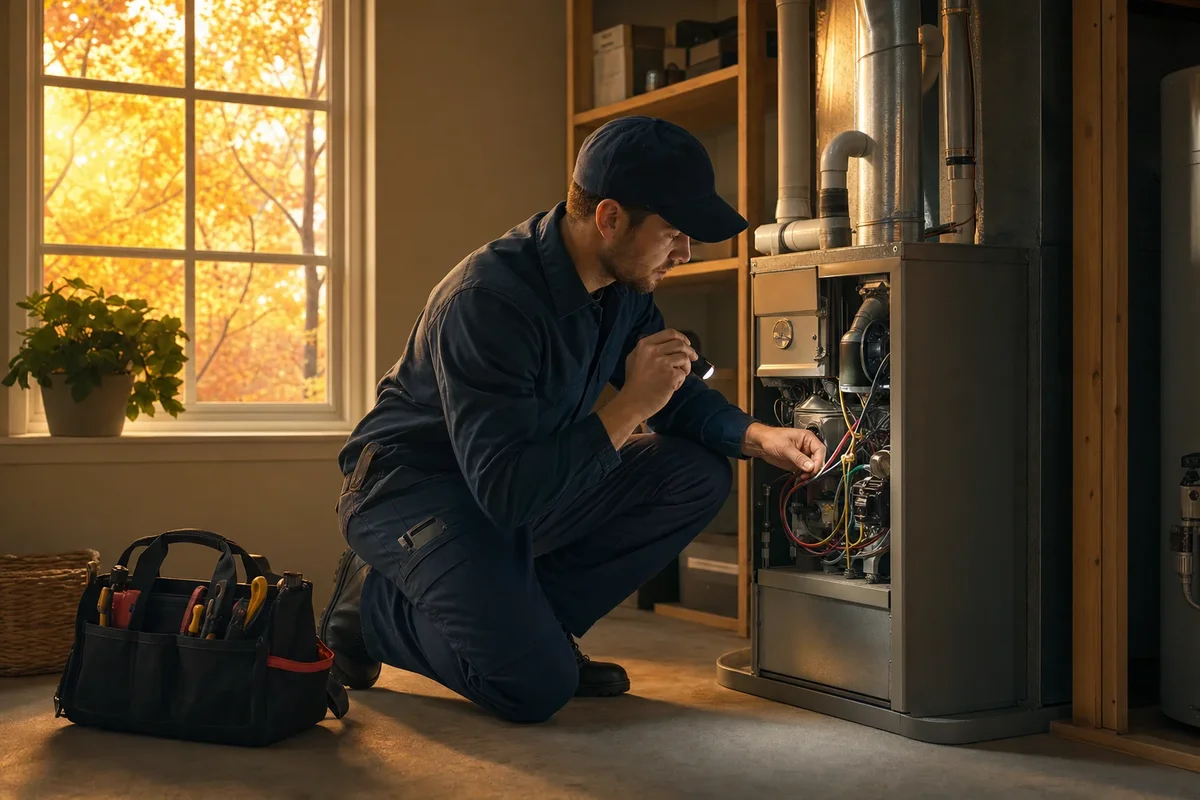
Winter Comes on Schedule. The Furnace Guy's Calendar Doesn't.
Every fall, the same checklists make the rounds. "20 Things to Do Before Winter." You skim it, feel a low hum of dread, and file it under "soon."
Fall maintenance has a problem that spring maintenance doesn't. In the spring version of this argument, the whole game was which tasks to spend on — roof and HVAC and plumbing return forty times what they cost, weather stripping doesn't. Fall is different. You still need to know which tasks matter. But the thing that actually costs you money in the fall isn't whether you do the work. It's when you book it.
A furnace tune-up in September and a furnace tune-up in December are the same work. They are not the same price, and in a cold snap they are not even the same service — one is a scheduled appointment, the other is you on hold with an answering service while your resident sits in a 52-degree living room.
Fall maintenance is a runway, not a checklist. The value is in the lead time.
The Runway Principle
Furnaces fail on first ignition. A system that ran fine all summer sits idle for months, then the first cold night arrives and every furnace in your market fires up on the same evening. Cracked heat exchangers, dead igniters, seized blower motors — they all announce themselves in the same 72-hour window.
So the whole market calls at once. In September, every HVAC tech in town has open slots and is happy to book a $150 tune-up. By mid-December, those same techs are triaging no-heat emergencies and quoting premium after-hours rates to whoever's left. Same technician, same furnace — the only variable you changed was the date on the calendar.
From what I've seen across fifteen years of doing this, the landlords who stay calm in January are the ones who booked in September. Not because they're better operators the rest of the year. Because they got in front of the rush while the runway was still open.
Rank the Tasks by the Cost of Skipping Them
A flat checklist tells you to do everything. Useless when it's October and you have three free weekends and a budget. So rank the fall tasks the way you'd triage anything else: by what the failure costs you if you skip it, and by how fast the booking window closes.
Here's the order I work in.
1. Heating service — book this first
A furnace tune-up runs $150-$250. A no-heat emergency in January runs whatever the market will bear, plus a habitability clock that starts ticking the moment your resident gets cold. And a cracked heat exchanger carries a carbon monoxide risk you're legally on the hook for. This is the one task where the booking window and the safety stakes point the same direction: do it now, in September or early October, before the first cold snap turns your tune-up into someone else's emergency.
2. Water heater check
Flush the sediment, test the pressure-relief valve, check the anode rod. That's $100-$200 of preventive work. A water heater that quits in December is a no-hot-water habitability complaint; a tank that lets go is a $1,500 replacement plus whatever the leak soaked on the way out. Water heaters live about 8-12 years and almost always fail in winter, when the incoming water is coldest and the tank works hardest.
3. Chimney and heating-source check
If the property has a fireplace, wood stove, or pellet stove, get the flue swept and inspected before your resident lights the first fire. Budget $150-$300. A blocked or cracked flue vents combustion gases into the living space instead of up the chimney. This one rarely makes the checklist, and it has the highest stakes on the list when it goes wrong.
4. Gutters — after the leaves drop
Clogged gutters in a freeze-thaw climate are how you get ice dams: meltwater backs up under the shingles, refreezes, and works its way into the wall cavity. It costs $100-$200 to clear them. Time it for after the leaves have actually fallen — a gutter cleaning in early October, before the trees are bare, just gets undone by November.
5. Exterior seal and drainage — including the hose bibs
Walk the perimeter. Re-caulk the gaps where cold air and water get in, and confirm the grading and downspouts push water away from the foundation instead of toward it. Then handle the single most important five-minute job on this entire list: disconnect every garden hose and shut off the exterior spigots.
A hose left connected over winter traps water in the bib. It freezes, it expands, and the pipe splits — often inside the wall, where you won't see it until it thaws and floods. A burst pipe is the most expensive thing on this page by a wide margin. Insurers put the average water-damage claim north of $11,000, and a supply line that runs unnoticed can clear $5,000 before you've even filed. The prevention costs a tube of caulk and five minutes per spigot.
6. Irrigation blow-out
If there's a sprinkler system, get the lines blown out with compressed air before the first hard freeze. That's $75-$150. Skip it and the underground lines and the backflow preventer freeze and crack — a $1,000-plus repair in the spring to fix something a single fall appointment would have prevented.
Your Vendor Bench Is Bookable in September. In December It Isn't.
All of this assumes you can actually reach the people who do the work. In September, you can. Your plumber picks up, your HVAC tech has a Tuesday open, and the shoulder-season rate is real — most trades discount their peak pricing to fill a slow calendar, often by 10-20%.
This is exactly what a vendor bench is for. If you've already got three-deep coverage in heating and plumbing, fall is when that off-season recruiting pays off — you call people who know your name, and you get priority scheduling instead of an answering service. If you don't have a bench yet, fall is the second-best time to build one, because the vendors you want are still reachable and not yet buried in emergency calls.
Turn Your Residents Into Early-Warning Sensors
You can't walk every property every week. Your residents are inside them every day, which makes them the cheapest diagnostic tool you have — if you give them a reason to report.
Send one short seasonal note before it gets cold. Three asks:
Change the furnace filter. Mail them a spare or two if you want it done right. A clogged filter is the number-one cause of the "the furnace stopped working" calls that turn out to be nothing.
Keep the thermostat at 55 or above, even when traveling. This is the freeze-prevention ask that matters most over the holidays. A house left cold with the heat off is how pipes freeze from the inside.
Report drafts and cold spots now. A resident who texts "there's a cold draft by the back door" in October is handing you a free inspection. Fixing it costs a tube of caulk. Ignoring it costs a heating bill they'll resent by February.
Most owners never send this note. It takes ten minutes, and it converts your residents from silent bystanders into the first line of your maintenance system.
No-Heat Is the Fastest Habitability Complaint There Is
Everything on this list ladders up to one stake. Of all the ways a rental can go sideways, a resident with no heat in winter is the fastest to escalate — it's the complaint that jumps straight from a text message to a code call or a repair-and-deduct, because heat isn't a luxury and every jurisdiction treats it that way.
Deferred maintenance compounds. That's the whole mechanism behind the accidental slumlord drift — not one dramatic failure, but a series of "I'll get to it" decisions that stack until something breaks at the worst possible moment. The fall runway is the cheapest place to interrupt that slide, because a September appointment is a decision you make on your own terms, and a January emergency is one the weather makes for you.
Book the Runway Before You Need It
A plane doesn't take off from a standstill. It needs runway behind it before the wheels leave the ground. Fall maintenance works the same way — the work you want done in December has to be booked in September, because the runway in front of you closes a little more every week the temperature drops.
Winter arrives on the same date every year. The only open question is whether you'll be the one who called in the fall, or the one calling when the lines are already full.